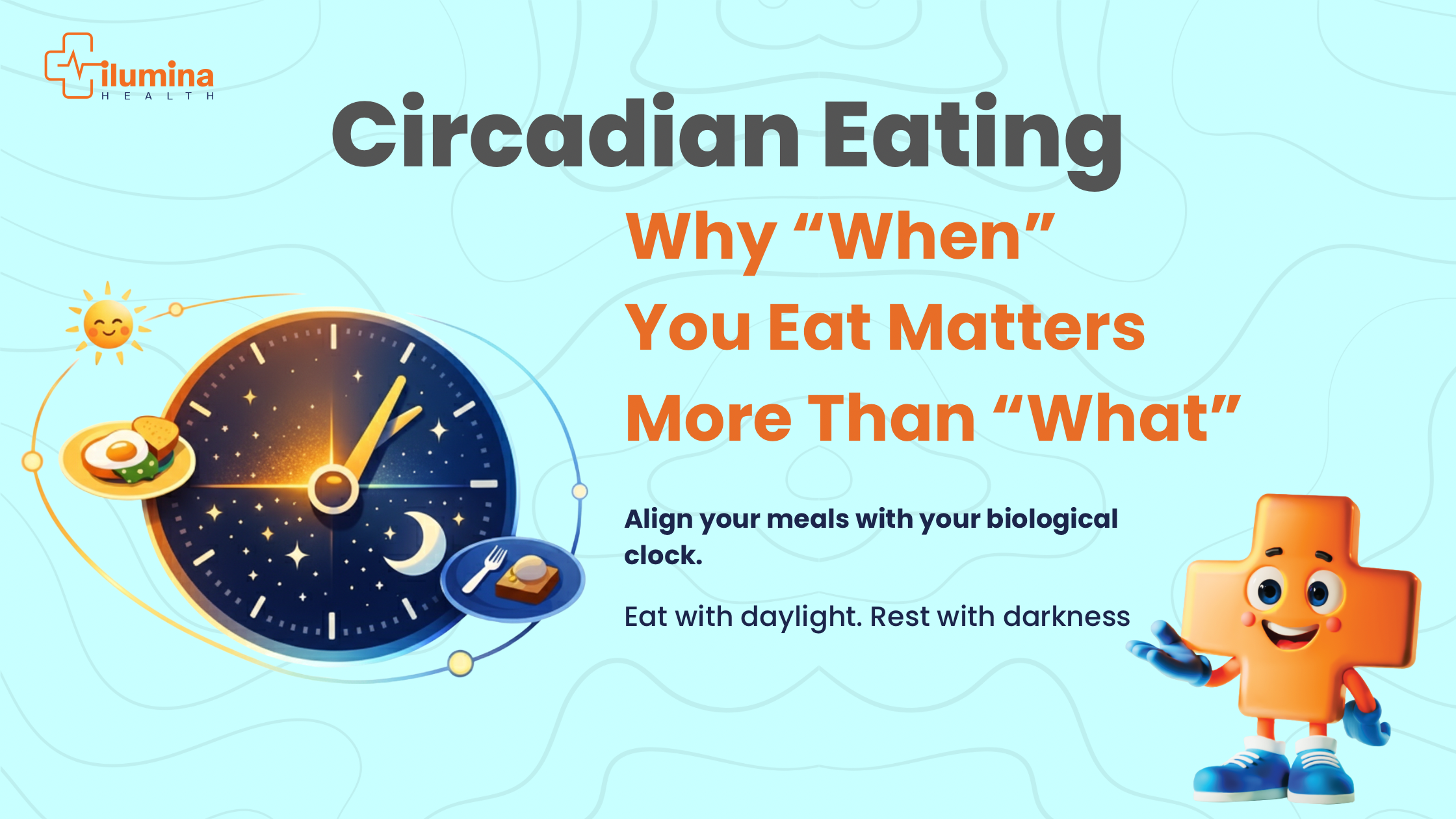

We’ve all been there: staring into the fridge at 10:00 PM after a long day, wondering if that “healthy” snack is actually a good idea. For decades, the wellness world has obsessed over the “what”—counting every calorie, weighing macros, and debating plants versus proteins. But as we move through 2026, a new light is being shed on a much simpler truth: Our bodies aren’t just metabolic machines; they’re biological clocks.
At Ilumina Health, we believe the best health advice doesn’t feel like a chore; it feels like an “aha!” moment. Understanding your circadian rhythm is exactly that.
The Science of Getting in Sync
Think of your body like a busy household. During the day, the “staff” (your cells) are energized and ready to handle deliveries. But at night, they need to clean up and rest. Every cell in your body has a tiny molecular clock, and when you eat against that rhythm—like those midnight snacks or heavy late-night dinners—you’re essentially creating “metabolic jet lag.”
Recent research in Frontiers in Physiology (2025) confirms that our insulin secretion follows a strict 24-hour cycle. It peaks in the morning and drops significantly as the day ends. When we eat with the sun, we’re working with the team; when we eat late, we’re forcing a tired crew to go back to work.
The Daylight Advantage
Your body is biologically “primed” to process fuel when it’s light out. A major 2025 study from the Universitat Oberta de Catalunya found that what you eat for dinner is the biggest driver of your blood sugar levels the next morning.
As the sun sets and your brain starts prepping melatonin (your sleep hormone), your digestive system begins to “power down.” If you force a heavy meal into your system at 9:00 PM, you’re asking a sleeping engine to run a race. The result isn’t just a restless night; a January 2026 Lancet review linked this constant internal “clash” to higher risks of systemic inflammation and even long-term cognitive decline.
Illuminating the Path: 3 Steps to Timing Your Nutrition
You don’t need to be a scientist to fix your timing. Here’s how to start:
- The 10-Hour Window: Try to keep your meals within a 10-hour block (say, 8:00 AM to 6:00 PM). Research by Dr. Satchin Panda at the Salk Institute shows this “time-restricted eating” can protect your heart and metabolism even if you don’t change a single thing about what you’re eating.
- Front-Load Your Fuel: Flip the old habit. Try making breakfast and lunch your main energy sources when your body is strongest.
- The Sunset Rule: Try to finish your last bite at least three hours before bed. This lets your body stop worrying about digestion and start focusing on the “cellular repair” it needs to do while you sleep.
The Bottom Line
Health isn’t just about the fuel you put in; it’s about the timing of the spark. By aligning your plate with the planet, you aren’t just dieting—you’re harmonizing.
At Ilumina Health, we know that finding your rhythm in a busy world can be tricky. If you’re ready to personalize your nutrition to your own unique biological clock, our specialized dietician services are here to help. Let’s work together to illuminate a path to health that finally feels effortless.
Sources & Further Reading
- The Salk Institute (2025): New Findings on Time-Restricted Eating and Healthspan
- The Lancet (Jan 2026): How Circadian Rhythms Impact Long-term Brain Health
- Frontiers in Physiology (2025): Circadian Rhythm and Glucose Metabolism
- UOC Health Research (2025): The Last Evening Meal and Its Impact on Insulin Sensitivity